by Joe Mehaffey and Jack Yeazel
Draft 5, 23 March 2001
 .
.
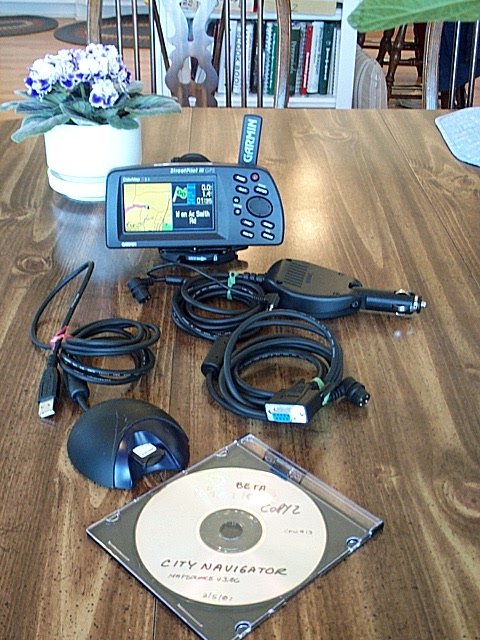
StreetPilot III Kit Components
.
StreetPilot III Kit Components
More StreetPilot III Photographs
The Garmin ColorMap StreetPilot III is in Garmin's fifth generation of GPS receivers with street level mapping. It is their first model with a) AUTOMATIC ADDRESS-TO-ADDRESS ROUTING (A2A)and VOICE COMMAND OUTPUT (VCO). With this unit and a copy of Garmin's (NavTech derived) CityNavigator mapping program a user will have the most detailed highway and residential street level maps available for the USA today. Currently, the USA coverage area for NavTech maps is the (approximately) 120 largest metropolitan areas. Outside these metro areas, enhanced "base maps" cover the entire USA with a map of major highways and interstate freeways. The SP-III allows a user to automatically route using both the CityNavigator maps and/or the Base Map. Thus, you can automatically route from an address in New York City to San Francisco with only CityNavigator map sections for NYC and SFO loaded. The base map will provide information for all highway routing between metro areas. SP-III is the only autorouting system that I am aware of that can do this sort of intercity routing without the need to load intermediate maps as you go from one NavTech region to another. (There are 10 NavTech regions in the USA.)
We think the ColorMap StreetPilot III Ver. 2.10 is a "break-through" in portable (move from car to car easily) address-to-address automatic routing GPS car navigation systems. It was designed from the ground up to economically replace the combination of GPS/Laptop Computer/Mapping Software system that many of us use to maneuver around cities in the USA (SP-III CityNavigator automatic routing maps only available for the USA at present, Europe in late 2001). SP-III includes a set of "base maps" showing all state and federal highways and major thoroughfares in towns and cities throughout the USA. In addition, SP-III can be loaded with optional RESIDENTIAL street-level detail maps of major USA metropolitan areas using map memory cartridges uploaded with data from Garmin's CityNavigator, MetroGuide and MapSource CDROM map systems. These include: CityNavigator (NavTech Maps, the best GPS routeable maps available in areas covered), MapSource MetroGuide USA (version II), (Etak Maps, good maps but less up to date and does less efficient automatic routing, Roads & Recreation, USA Topo, and WorldMap CD ROMs. 8, 16, 32, 64, and 128 megabyte memory cartridges are available. (Our recommended minimum size is 32megs which is the size that comes bundled with the SP-III kit.) With SP-III, the "map chunk" limit has been extended to about 535 so there should be no problem in filling up a 128meg memory with any of Garmin's mapping products.
The CityNavigator (NavTech) map offering is necessary for the Automatic Address-to-Address routing to work to street address level. We have reviewed the VDO Dayton, and the Datus RouteFinder A2A/VCO systems previously and have used the Magellan 750Nav units. The SP-III provides automated guidance on a par with any of these and in fact much more routinely gives routing "the same as I would have chosen". Sometimes the route chosen is "just OK", but after all, SP-III is just a machine.
CityNavigator maps do not offer street level detail of the entire USA. However, (uniquely with SP-III) if you want detailed street level coverage for an area outside the 120 large USA metro areas, it is possible to load MetroGuide or R&R maps to fill in the missing areas. Note: When I speak of a "Metro Area" with respect to CityNavigator, it includes many towns around a large city. For example, In the Atlanta Metro area is included: Roswell, Tucker, Cumming, Alpharetta, College Park, Decatur, and a dozen and more small towns. The main Atlanta "map chunk" is about 5 megabytes, and other area "map chunks" range from 400kbytes to 1.5mbytes. Thus, more efficient use of map memory is possible with CityNavigator as compared with MetroGuide.
Note that A2A automatic routing is NOT available except in areas with roads provided by either the Base Map or the CityNavigator maps. (This same metropolitan area limitation has been present in every A2A automobile navigator we have used including 750Nav, VDO, Alpine, and Datus. Rumor has it that NavTech will have full USA coverage by the end of 2002.) You can route to covered highway intersections just using the basemap.
CityNavigator and MapSource 4.xx offer the user a new (for Garmin) capability of generating a route automatically ON THE PC as well as within the SP-III. This permits users to generate a series of automatically generated routes and load these into other Garmin GPS receivers as well as the SP-III. (We have not yet tested this with models other than SP-III.) The CityNavigator (NavTech) maps offer coverage of the covered USA Metro Areas with superior road detail. Details as to which lane to be in and which way to turn onto exit ramps at complex expressway interchanges is included.
While CityNavigator has "city area map chunks" ranging from about 23kbytes to 5 mbytes, Metroguide II has map sections in 1 to 2 MB "chunks" whereas the Roads & Recreation Maps typically load "county size chunks" which typically use 100K to 400K bytes of memory per county. In the Atlanta area, the coverage area for a selected 8 MB ETAK or CityNavigator map section is roughly a square about 125 miles on a side. This covers the formal "Atlanta Metropolitan Area" and then some. Using the less accurate (but still very good) MapSource R&R maps, you are able to include a much larger area in an 8 meg memory cartridge. (See the MapSource Product Information for more detail.) Note: As of this date, NO OTHER map products (from alternative vendors) can be uploaded into Garmin GPS receivers except those offered by Garmin for the purpose. This same proprietary relationship exists for other vendor's consumer GPS products as well.
This new SP-III is designed principally for automobile use and its size, the two hour(or so) battery life and lack of off road features make it unsuitable for hiking or boating use. NiMH rechargable batteries give better service than alkaline.
What's new in StreetPilot III?
We can say that SP-III gets rid of almost ALL of the error effects of GPS error that bothers so many people. When you use CityNavigator or MetroGuide the SP-III will "lock" your vehicle track to roads and as long as you travel on the road. (This feature does not operate with MapSource R&R, USA Topo, or WorldMap.) Automatically generated routes using CityNavigator maps "rubber band" to the roads in the route without fail.
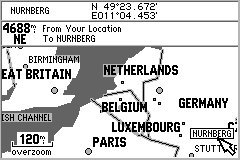
Another useful feature is that with CityNavigator (and MetroGuide) maps, all approaching cross street names are displayed prior to arrival. We found the SP-III audio and visual guidance directions very satisfactory. SP-III automatically varies its "turn here" warning time to give you more warning time at high speed than at lower speed. A typical audio/visual sequence would go something like this:
An alternative screen shows a listing of turns to come. Another screen display is the trip computer.
AUTOZOOM zooms the screen in and out automatically as you approach waypoints and turns so you always have time to make decisions.
Route selections for CAR, TRUCK, BUS, and EMERGENCY are provided so you can be properly routed depending on your vehicle type.
The accessory CityNavigator and MetroGuide
Maps contain thousands of "attractions" on
board. These include:
Food and drink, Lodging, Attractions,
Entertainment, Shopping, Services, Transportation,
and Emergency and Government. In our area,
there were a few restaurants we had not known about (and
a few prominent ones are missing).
The restaurant listing appeared to be about 2 years old. Listed
"Attractions" include theme parks, museums, libraries,
schools, parks and such. The listings were
quite satisfactory though the placement of a particular restaurant
or gas station might vary plus or
minus a few hundred feet (once, half a mile)
from the actual location. This feature
could be very handy in a strange city.
The user can give the GPS a Street Address or Street Intersection or select one of the, for instance, Restaurants in the accessory map data base module and it will LOCATE this address or location automatically and plot it on the map screen. The SP-III can then automatically create a "turn-by-turn" route to this destination from wherever you are. This is a very useful feature and it has worked very well in our tests. Be prepared for a few well known items (such as my local library) to be missing from the "attractions" list. Still, if you are unfamiliar with an area, what IS included will be quite useful.
What are the Technical Specifications of the SP-III?
Specific Questions Answered:
The trip computer is improved and has functionality
similar to the SP(CM). With SP-III, You will notice that when
you come to a stop, the estimated times do not go to
infinity, but hold a realistic value. The GPS calculates
estimated times based upon road classes in your Route and modify
the estimation by your actual speeds on the various road
classes. It also computes the actual road distance between turns
(waypoints) instead of using straight line distances. The results
give fairly accurate estimated time to various points,
even when using different road classes, like traveling
on the freeway, and then exiting later on
some local roads. Your estimates will not only be based
upon your current highway speed, but by the combination of speeds
you are using, or will be using on the various road classes.
The GPS has the standard HOST mode which allows the upload/download of waypoints, routes, tracks, etc., OR use the GPS for tracking with the NMEA output WITHOUT having to change from GARMIN to NMEA mode and vice versa. The SP external power/data cable and active antenna BNC connection is the same as for the G-III(+) and G-II(+) and earlier SPs..
StreetPilot Feature and Function Highlights
We do not recommend SP for hiking or marine activities due to its reduced feature set optimized for automobile use.
The SP (CM) includes the G-III+'s Overview Map of the World. However, the basemap has less detail in South America and no railroads, but more roads in Canada and Mexico plus maps of USA interstate, national, primary and secondary state highways, cities, larger towns, waterways, rivers, and coastlines. areas outside the Americas. (Note: See Garmin Base Maps description for more information on Base Map content.) Base Maps are included in the SP-III's internal memory while USER Uploadable Street Maps on CD ROM provide street level or topo detail of user selected areas are loaded to the 32 meg (standard) or 64 or 128 meg memory cartridges. (Note: older 8 meg and 16 meg cartridges can also be used with SP-III.)
Additional SP features include:
Note: None of the "display fields" are user configurable in SP. A "satellite" page (menu/menu+GPS INFO) rounds out the active displays. Another display shows loaded maps and allows user selection of "active" maps. We are not sure why you would want to turn any of the loaded map sections off.
MetroGuide's Find-an-Address includes: Intersection, Place, Restaurant, Hotel, Entertainment capability. SP (CM) can find such places in the upload coverage area. Even a restaurant less than one year old were included. However, some of the locations of restaurants, hotels, etc. are misplaced by considerable distances.
A "Driving Status" line on the Map display indicates such information as "Driving South on Roswell Road near Sandy Springs". This can be quite useful in cities where you don't exactly know which street you are on. Also while driving, the name of each approaching side street is displayed allowing finding side streets in the dark.
Major features the StreetPilot DOES NOT have compared with G-III+
Datums- The SP only provides WGS-84 so any external mapping program which cannot use WGS-84 directly OR convert WGS-84 to its required datum will give larger than normal map position errors.
Battery timer- The SP has no battery timer feature. It does have a battery "fuel gauge" display and MORE IMPORTANT, SP-III has an "Automatic Shutdown when External Power is Removed" feature to prevent running down the internal batteries if you forget to turn off StreetPilot in your car. Unfortunately, it does NOT have automatic power ON when external power is applied like other Car Navigation systems.
Fifty ICONS are available in the SP to identify user waypoints and mark routes. The battery meter can be set to alkaline, or NiCad types. Alkaline battery life in the SP (6 AA cells) is about 2 hours.
Street pricing of the SP-III is about US $850 or less and includes: 32 meg memory cartridge, speaker/power cable CityNavigator CDROM and a password key for one (of 9) USA regions.
Features and Operation
The SP-III has a direct and easy to use routing system. The user:
The SP-III operates from 6 AA batteries or from external power in the range of 10 to 32 volts DC. The SP-III uses FLASH memory and has no memory backup battery. We get about 2 hours from a set of 6 Toshiba/Sony Alkaline AA cells. Best to keep the unit plugged into external power. The LED backlit display lighting has a rated design life of 100,000 hours. The SP shuts down when the internal battery voltage goes below 4.8 (alkaline) or 5.2 (NiCad) volts unless external power is applied.
The data/power cable used is the same as the Garmin G-45/12/II+/G-III+ and other SP units. The external antenna connector, a BNC coax jack, is located on the right rear of the unit just behind the keys. The BNC jack is powered and has a current limit rated at 50 ma to protect the unit from shorts on the antenna cable. However, the standard antenna is passive. The Garmin GA-26 amplified antenna, Lowe's, Tri-M, and the MAGELLAN M-4000 amplified antenna all work with the SP. We believe most other amplified GPS antennas will work as well.
The SP-III outputs out only the NMEA protocol NMEA-0183 ver 2.0 and accepts RTCM-0104. Other proprietary GARMIN sentences are input/output as well. Garmin has included its (now) standard HOST MODE (Called GARMIN in the GPS) so that (with suitable software commands) it is now possible to switch from NMEA to up/download without manual intervention. The NMEA out, TEXT out, DGPS in, and RTCM in are also available.
DGPS signals in the RTCM-0104 format are accepted. Anytime NMEA output is selected, the baud rate of the output serial port is set to 4800 baud and input is disabled or it can be set for RTCM in and NMEA out. RTCM (DGPS) alone can use baud rates of 300 to 9600. A setup screen permits selection of the I/O combination needed by a particular application.
Operating temperature range is specified as -15C to +70C. Unique in their class, Like other Garmin handheld GPS receivers, SP is rated submersible to one meter per IEC529 IPX(7). The maximum altitude rating is 60,000ft and speed maximum is 999 knots.
Feature Details
Jack Yeazel and I have tested the SP on the roads and highways of North Georgia including one interstate trip. Our SP has worked properly at all times as far as we could tell. We tried uploading and downloading waypoints, tracks and routes using G7ToWin. We tried it out on SA5, 6, and 7, Precision Mapping 3, Vista, AutoRoute 5. Generally tracking worked well, and SA7 upload/download functions worked OK. (However, most upload/download programs will require later releases for all of the new SP functions to upload/download properly. Examples: 50 icons, One 10 character names, commands to use Garmin's new "no touch" switch over from NMEA to UPLOAD/DOWNLOAD. All map programs tested which specified a NMEA-0183 ver 2.0 data stream as input tracked properly with the SP.
We compared the SP with the G-12XL, G-III+, G-II+ and the EEx2. The SP performed on a par with all units in every test for lock stability, multipath performance, re-lock after an underpass, and ability to suddenly change direction without loss of lock. The SP laid down smooth tracks on our highway maps during all tests. No gaps, jumps, etc., (The SP has data smoothing like the G-III+.)
We noted that both the SP and G-III+ (along with the G-12XL and the G-II+) have a form of "dead reckoning" for moments when signal dropouts occur. For instance, if the SP is tracking along and just before a sharp turn you invert it and block its antenna, it will continue to track straight for about 30 seconds. It also provides a very good data smoothing filter to throw out random fixes that are way off track. This results in an exceptionally smooth track on a moving map display even with the "road lock" option turned off. Even with this filter, there was no overshoot apparent during quick stops, sharp turns, and similar maneuvers when normal continuous tracking was taking place.
SP performance under tree cover and city canyon conditions was about the same as the G-III+, G-II+, G-12XL and the EEx2 and we rate that as very good.
We found the display controls easy to learn and use. The menu system and arrangement is quite satisfactory, but took some time with the 70 page manual. The SP has many feature changes as compared with the G3 and other handheld units. However, after a couple of hours of operation, we found the SP's simplified menu system both adequate and easy to use.
Since the SP-III, SP, G-III+, G-12XL and the G-II+ exhibited essentially identical tracking performance in our tests, we did not perform the extensive field trials we made with the G-12XL, EE, and others. For more information on tracking results with our testing of the G-12XL, and the G-II+ see our reviews at: http://gpsinformation.net/main
Summary
Our overall impressions are that the StreetPilot III is a new generation of low cost Automobile Navigation Systems. With the lowest price of any truely automatic self contained address-toaddress car navigation system and the superior NavTech street maps, we consider the SP-III to be revolutionary in its price class. With the SP-III, I believe we can eliminate having to use paper maps for car navigation (in the covered areas).
What DON'T we like about
the StreetPilot III?
1) The unit drains batteries extremely
rapidly. It will be extremely advantageous to operate it from
external power. This problem is mitigated by the "automatic
shutdown when external power is removed" feature.
2) The CityNavigator software for one of ten
regions of the USA comes bundled with SP-III. Additional regions
cost about $99 and the bundle with "all the rest" of the USA costs about
$200 or so. Many will opt right away for the "entire
USA". This is a bit pricey for many buyers, BUT> it is
the best car navigation map system that you can buy and Garmin's price
is MUCH less than other car navigation vendors charge for the same map
capability. These are apparently the same maps that are used in the
$2000/$3000 car navigation systems.
3) The simulator is a bit hard to steer and
gets off track now and then, but this is "picky".
4) We would like to see the SP-III power up
automatically when external power is applied.
Which GPS do I use now when I go on automobile trips? The StreetPilot III. Would I take it hiking or boating? No.
If anyone has any additions, questions, suggestions, error corrections other comments, please feel free to Email Jack or Joe.